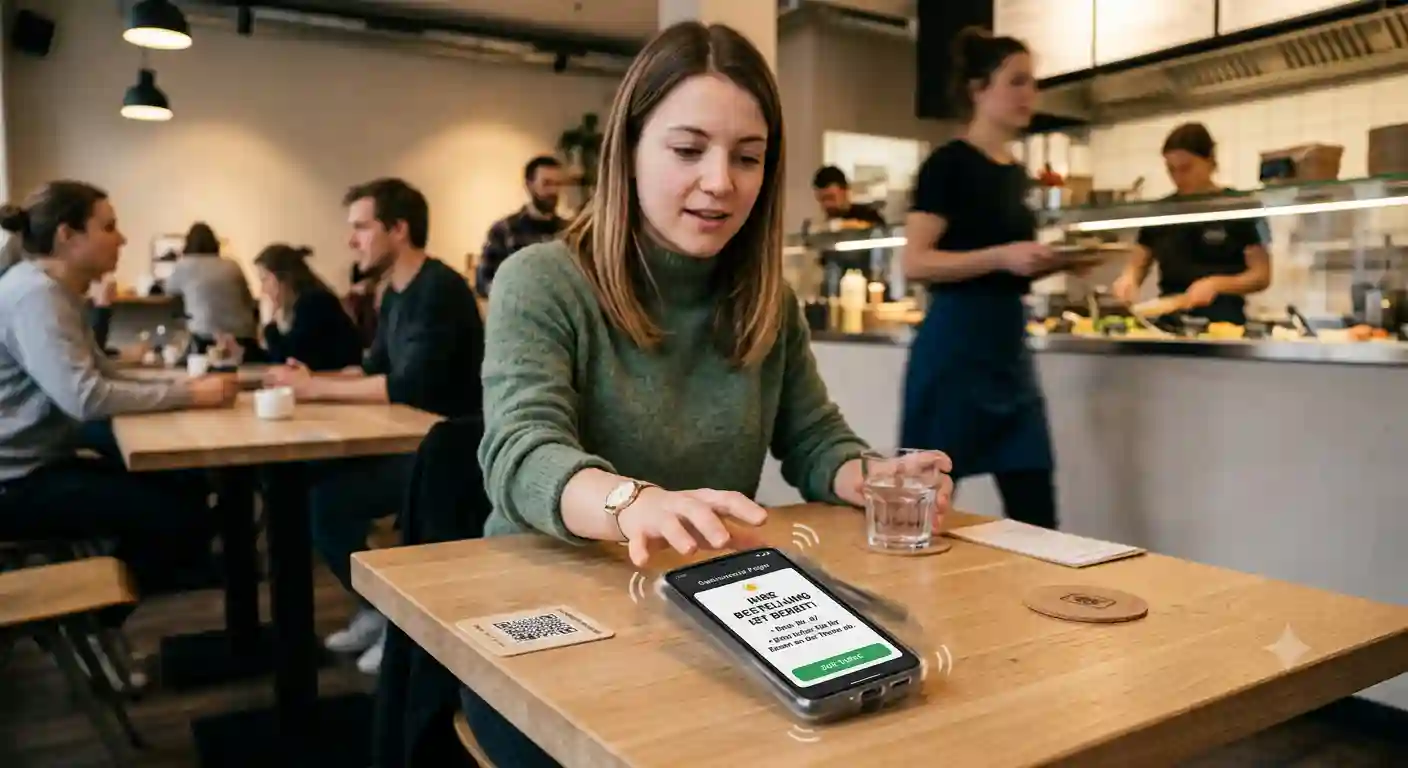
Some call it a restaurant pager. Others say buzzer, vibrator, or coaster pager. They all mean the same thing: the little device that tells the guest when their food is ready.
The idea behind it is spot on. The implementation, however, is outdated. These devices cost money, break, disappear, run out of battery — and in the end, they deliver exactly one piece of information to the guest: "ready."
There's a better way. Without buying a single additional device.
The Pager System That's Already Built In
With DJ Beat & Bite, you don't need to buy a separate pager system. It's already part of the gastro module — and it works in two ways simultaneously. This is exactly where classic buzzers and most apps fail: they force every guest into the same workflow.
But your guests aren't all the same. The 24-year-old wants to do everything on their phone. The regulars at the next table, both over 70, want to order at the counter with a friendly word — and that's perfectly fine. Both should be served. Both should know when their food is coming.
Way 1: The Phone Becomes a Personal Pager
The guest scans the QR code at the table. No download, no app, no sign-up. Their own smartphone becomes their pager — and a much smarter one than any buzzer ever was.
Alert Sound When the Food Is Ready
As soon as your kitchen marks the order as ready, the guest gets an alert sound directly on their phone. They don't need to keep staring at the screen or glancing at the counter. The phone chimes — just like a buzzer, only without the buzzer.
They See the Complete Journey of Their Order
A buzzer can beep. That's it. The interactive kitchen traffic light shows the guest in real time what's happening — your kitchen advances the status with a single click:
- New — the order has arrived.
- In progress — the kitchen has started.
- Served — the food is out.
- Table closed — all done.
This might sound like a small detail. But it's the difference between a guest who feels forgotten and a guest who stays relaxed. Wait time you can see feels shorter. And the question "How much longer?" — which drives your staff crazy on a busy evening — simply doesn't come up anymore.
Order and Pay in One Go — with Stripe and PayPal
The guest doesn't just order on their phone — they can pay right there too. Stripe and PayPal are fully integrated — card payments via Stripe, plus PayPal Direct for those who prefer it. No waiting for the bill. No card terminal being carried across half the beer garden.
And you stay in control: online payment can be flexibly turned on and off. For the whole business, just the patio — or not at all, if you prefer to keep collecting payment at the counter.
The most important thing for your team: Tips don't get lost. They go via PayPal.me directly to the account of the individual server — not through the register, not through detours. How that works in detail is covered in the article Pay via QR Code.
Way 2: The Monitor with Number Call-Up
And now comes the part almost all providers forget: Not every guest has a phone. And not everyone wants to use one.
Older guests. People who are deliberately offline on vacation. The dead battery at the end of a long day. The family where only one person placed the order. If your system excludes these guests, you lose revenue — and often from exactly the customers who come back most loyally.
That's why there's a second way, brand new in the system: The guest orders the traditional way at the counter — in a personal conversation, as always — and gets a number. Outside in the beer garden, on the patio, or above the pickup window, the monitor with the number call-up is displayed. When the food is ready, the number appears there. Big, clear, readable from any seat.
No phone needed. No app. No explanation. The guest looks up, sees their number, picks up their food. Done.
This is the crucial difference: You don't have to choose between "digital" and "personal." You have both. At the same time. In the same system.
Why This Is Superior to Every Classic Buzzer
- No purchase, no leasing. Pager sets quickly cost several hundred to over a thousand euros — plus replacement devices, plus charging stations. Here: zero.
- Nothing breaks, nothing disappears. No device that falls down, gets left in the beer garden, or is accidentally taken home.
- No dead batteries. No collecting, no charging, no replacement buzzers because three are dead again.
- No range problems. Radio pagers often don't reach the back of the beer garden. A smartphone always has reception — and the monitor is hanging where everyone is looking anyway.
- No hygiene concerns. No device that passes from guest to guest and needs to be disinfected.
- The guest knows more. Not just "ready," but the complete journey of their order — with an alert sound when it's time.
- No one is excluded. With a phone or without — every guest is reached.
And the Kitchen? Doesn't Miss a Thing.
In the kitchen view, all orders arrive live, neatly sorted by table — with an acoustic alert for every new order. Nothing gets lost in the chaos, not even on a Saturday evening at half past eight. Plus the discreet kitchen statistics: you see what's selling and what's sitting, and purchase accordingly.
And all without expensive specialized hardware: A standard tablet or an old smartphone on the wall is enough. The monitor in the beer garden? A perfectly ordinary screen. Nothing more is needed.
Who Benefits Most
Anywhere guests wait and the distances are long:
- Beer gardens — where radio pagers fail on range and the monitor plays its greatest strength.
- Beach bars & beach clubs — the guest stays on the lounge chair and still knows what's going on.
- Self-service restaurants & canteens — the classic buzzer use case, just without the buzzer.
- Cafés & bakeries — high frequency, short wait times, packed counter.
- Food trucks & fast food — the line dissolves because no one has to keep standing at the window.
- Restaurants with patio or courtyard — long distances without the server constantly going back and forth.
- Club houses, festivals & events — rotating helpers who can't learn a complicated system.
- Hotels & campgrounds — large premises, seasonal staff.
What It Costs: Nothing Extra
The pager system is not an add-on module you need to book separately. It's part of the gastro module — together with the digital menu, QR ordering, the kitchen traffic light, the monitor call-up, Stripe, PayPal, and the tip function.
€14 per month. 10 tables included, indoor and outdoor. From the 16th table, just one euro more per month. Cancel monthly, no setup fee. Compare that against a buzzer set.
Made in Germany, 100% GDPR
DJ Beat & Bite is fully developed in Germany and runs on German servers. Encrypted transmission (HTTPS), automatic data deletion after 90 days. Not some anonymous overseas website builder — but software with German support, where you know where your data is.
Conclusion
Buzzers, vibrators, pagers — whatever you call them: you no longer need a box full of devices for that. One guest already has their pager in their pocket and gets their alert sound. The other looks at the monitor and sees their number. Both know when their food is ready. And you haven't spent a cent on hardware.
Try the gastro module free for 30 days — QR ordering, digital menu, kitchen traffic light, monitor call-up, payment via Stripe and PayPal, plus the tip function. No risk, cancel monthly.